

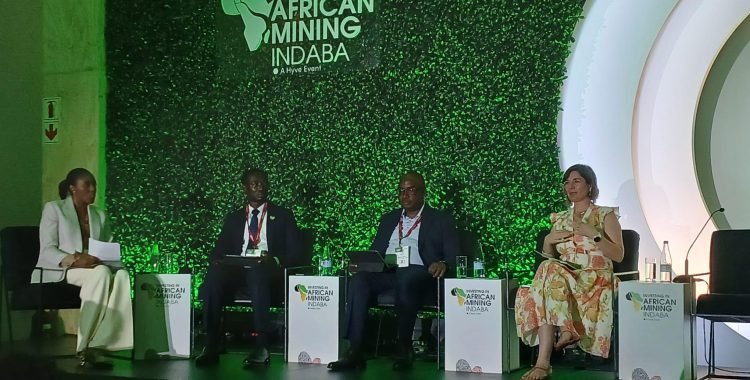
During Mining Indaba 2026, Levin Sources’ CEO and Founder, Estelle Levin-Nally, spoke on a panel about the importance of gold for Africa’s development. The panel was moderated by Nere Emiko (CEO, Kian Smith Company), and led with interventions from Ishmael Quaicoe (Director - Responsible Mining & Sustainability, Ghana GoldBod) and Itai Chirume (ED, MMC), who set out how gold has had a stabilising effect on these countries. The below is an edited transcript of Estelle’s remarks.
When governments are intentional, gold becomes a game-changer
Both Ghana and Zimbabwe show that when a government is intentional about the gold opportunity and meaningfully harnesses it by putting the right structures in place and by responding to market jitters around hyperinflation or informality, gold can be critical for unlocking broader economic development. It becomes a key to stabilising currencies and driving investor confidence.
Take Mali, a country where Levin Sources has been working for several years. Mali’s gold sector faces several challenges, one of which is that the government lacks a strategy for driving sustainable development through its artisanal and small-scale mining (ASM) sector. That sector is a very significant part of the economy, but the lack of political will to take meaningful control of it leaves the participants of that sector vulnerable to exploitation and abuses and makes it difficult for other potential allies to responsible ASM (e.g., industrial miners, mineral offtakers) to take action. Mali is simply not getting as much out of its gold sector as it could be, and a lot of the gold’s value is being offshored.
Government as business partner, not just regulator
When governments actively support their ASM gold sectors, as Ghana has done, they become business partners as well as regulators. That may present a conflict of interest, but this can be managed through good governance. What it means is that the government now has more than just a political interest in enfranchising miners and traders to operate within the law. It has a business-based interest to work as partners, to support their professionalisation, their access to responsible capital, their introduction of cleaner technologies, and the avoidance of waste.
If a government is going to directly benefit from gold and stabilise its currency through it, then it wants to make sure that for every dollar invested in the ASM sector, high percentages of the resource are not being lost as waste because of inefficient production systems. This changes the political economy around who takes an interest in artisanal and small-scale mining. It opens up the possibility for partnership-based development of the sector, rather than abandonment to actors who are not interested in supporting the people and are only interested in extracting wealth into their own jurisdictions, or who may exploit the informality of the ASM sector to launder money from adjacent illicit activities. Political and commercial interests become aligned, and in a functioning democracy where artisanal miners have a sizeable vote, that can be powerful.
The staggering scale of artisanal gold, and why the micro level matters
The scale of gold production from the artisanal and small-scale mining sector in Africa is impressive. The rise in the gold price has created enormously greater value and opportunity within African ASM, and it feels neglectful when political leaders fail to be intentional about grabbing that opportunity.
The micro level really matters. Currency stabilisation is one of the most important things a nation can do with its gold to drive wider investment and trade, but at the individual and household level, gold is uniquely important in building resilience. In artisanal mining communities, people are very rarely doing only one thing. At both the individual and household level, gold provides the cash needed to cross-invest into other parts of the domestic and thus local economy. In markets where access to cash or working capital is constrained, whether for farming or trading, or because of the person’s identity, gold provides a stepping stone towards strengthening other parts of the economy. That is not very visible unless you sit down and talk to households about why they mine gold and how they use it to improve their family’s financial security and/or social status.
Gold and women’s economic empowerment
Gold is particularly important for women miners. In Africa, an estimated 50% of artisanal and small-scale miners are women. The ASM sector provides a vital opportunity for women’s economic empowerment at the individual, household, and community level, and that is something to be enfranchised and harnessed.
Yet numerous studies show that at the micro-economic level, women remain marginalised from the most productive roles and the greatest opportunities within ASM. Economies are underserved when women cannot fully participate and bring their best to the table. There is more value to be unlocked by ensuring women are equitably included in the gold economy and are fairly paid for the work they do and the gold they produce.
Gold in a multipolar world
Gold is a safe haven and a financial instrument, and that is one of the things that makes it unique among the minerals produced in Africa. In a global climate that is increasingly conflicted and competitive, where multilateralism is being reconfigured and not everybody is bought into it the way they once were, gold is important to everyone, regardless of political affiliation. All of the major political blocs are investing in gold production, procurement, and storage. The price of gold alone shows us clearly that it is critical to the global economy.
The national security dimension: benefits must be shared
It would be naïve not to mention that gold is not entirely beneficial in every way. Gold is a critical mineral for Africa and for the world because of its strategic importance and what it delivers. But without intention, without the right partners, and without distributing harms and benefits sensibly, that potential cannot be fully capitalised upon.
If everything is done to centralise control of gold but the benefits from that greater economic power are not redistributed to everyone along the internal gold value chain, the result will be greater destabilisation and resistance. There are many countries in Africa where gold is already playing an instrumental role in destabilisation at the local level. It is not enough just to invest in the economic aspects. A considered political approach is needed too to ensure that when gold lifts up economies, it doesn’t leave vulnerable or marginalised groups behind, because that is where conflicts become catalysed or deepened.
