

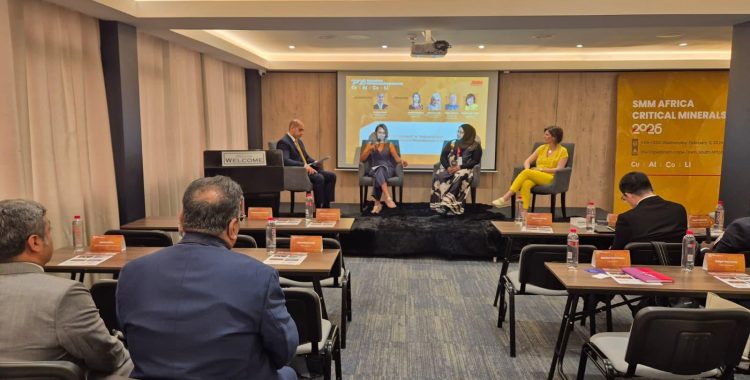
During Mining Indaba 2026, Levin Sources’ CEO and Founder, Estelle Levin-Nally, spoke on a Shanghai Metal Market panel about value addition, local content, and the impact of European due diligence regulations on producer nations. The below is an edited transcript of her remarks.
Minerals as a catalyst for economic development
As a sustainability adviser, I see minerals as a gift. They are an endowment that sits in the earth and takes a tremendous amount of human endeavour, intelligence, and cooperation to convert, not just into capital to reward the shareholders who have taken the risk, but as a way of catalysing economic development for the people whose land they are on. Achieving this takes intention.
It takes mining companies and their partners to really look at how they develop markets, not just downstream through jewellery and smelters, but also upstream through local content and the stimulation of beneficiation. When you think as a trader, and when you think from the commercial side of mining, it is very easy to forget the function you have in society for driving economic development. That is really where value addition sits. It does not just sit in the downstream piece. It sits in thinking creatively about all the linkages through which we can drive greater value for communities, the nation and the economy as a whole.
Responsible sourcing is an economic development issue
A couple of years ago, at the Indaba, while chairing the sustainability committee, I judged the responsible resourcing awards. One of the most exciting entrants was Base Resources, which demonstrated excellence across a number of categories. The one that sticks in my mind was their work controlling forced labour in their local supply chains.
Why does that matter from a value addition point of view? When you control labour risks in your contractors and suppliers, you are building dignified work that allows families and households to thrive, and through which broader economic development gets stimulated. When you do not control the risks of labour exploitation, workers do not have surplus. They do not have the freedom to diversify their household activities or invest in other things. So, responsible sourcing in local supply chains is not just a human rights issue. It is an economic development issue.
Women’s economic empowerment through local content
In many communities in Africa, women are culturally discouraged from participating in certain economic roles or from holding certain forms of political status. Yet we know that for every dollar a woman controls in a household, it goes much further in delivering child development, supporting child rights, and driving economic development. We uplift communities when we empower women economically through local content programmes that intentionally create opportunities for women and support them as entrepreneurs. That is a key and exciting opportunity.
EU due diligence regulations: what producer nations think
My team recently published a report for the German government examining how far Zambia, Indonesia, Mexico, and Brazil have progressed in their readiness to implement EU due diligence frameworks, including the EU Battery Regulation, the Conflict Minerals Regulation, and the Critical Raw Materials Act.
There were some striking findings. Across all four countries, awareness of the market requirements was greater among industry and civil society than within governments, which acts as a barrier for producer nations to prepare for and deliver into these markets. Zambia was the least prepared of the four. And opinion was roughly split down the middle as to whether these regulations were a good or a bad thing.
The benefits: rights, remedies, and competitiveness
On the positive side, the imposition of market rules was driving greater inclusion of rights holders in decision-making by industry and strengthening dialogue between rights holders and companies. That makes the industry better at controlling risk because they understand where rights holders are likely to be aggrieved, and they build the relationships needed to work together on mitigation.
We also found enhanced access to remedies. Where affected rights holders were victims of harm and had grievances, these market regulations made it easier for those grievances to be resolved and for people to be restored to dignity, which in turn reduces conflict risk for producers. By mandating these requirements, there is greater consistency of application for controlling environmental and human rights risks. That matters because although these nations have committed under international conventions to implement ILO conventions and the UN Guiding Principles, local enforcement is weak, domestic capacity is low, political will is low, and in many cases, civic space is narrow, making it difficult for media and civil society to advocate for stronger protections. For producers that implement these standards well, market access and competitiveness improve.
The costs: compliance burden, disengagement, and perceptions of colonialism
But it is not all rosy. The compliance burden falls disproportionately on small and micro enterprises. In my work with artisanal and small-scale miners, I have seen this play out very clearly, particularly through the Conflict Minerals Regulation. The risks are so great and so difficult to manage, the gap so huge between the risk appetite of a compliance-led market and the risk reality of aspirational but struggling small producers, and the lack of capital to support them to improve, that it leads to outright disengagement. That is absolutely not the right outcome.
We have also seen clients take a policing approach to compliance rather than committing to being a long-term, transformative partner. We need a partnership disposition if we are to bring these regulations to life and deliver on their intent: mutual benefit, mutual risk control, and mutual reward for both trading parties.
There is also the question of perception. In Zambia, for instance, market nation requirements were imposing expectations that did not align with the national strategy. That reduces local appetite to support implementation and creates conflict. These market regulations can be perceived as a form of colonialism if they don’t reconcile with and deliver upon the national strategies of producer nations.
Regulations are there to create value, not just ensure compliance
It is a mixed picture, not all good, not all bad. But we must remember that market requirements over producers are just one of several levers. Regulators, markets, investors, labour, and communities all have a role in driving accountability for more responsible business practices by companies. That matters because holding business to account protects value: you avoid share price collapses when miners die because they were illegally accessing your concession. And it grows value: you uncover new opportunities through stronger collaborations with local partners.
We need a different disposition when implementing these regulations. They may be regulations, but they are not there just for compliance reasons. They are there to create value.
