

This Insights piece draws on a Levin Sources-led publication produced for the 3-year EU Horizon project “DiliCHANCE”. See all the materials of the DiliCHANCE project on dilichance.eu.
Many businesses in the minerals sector practice some form of due diligence to manage their impacts on people and the environment. But 15 years after the UNGPs – and the alignment of the OECD Guidelines to UNGPs concepts – many businesses still struggle in their due diligence with ‘the doing.’ This is where businesses actually prevent, cease and mitigate risks and impacts – which is quite distinct from preparatory and enabling steps like establishing policies, undertaking risk identification and setting up management systems.
This challenge is particularly acute when the business is not causing the (potential) impact itself, but is connected to it through business relationships, such as in the supply chain. In the minerals sector, many downstream businesses have identified salient human rights and environmental issues at the minerals extracting and processing tiers of their supply chains, but they struggle to build and exert sufficient leverage to effectively prevent and address these issues. And mining companies themselves may recognise salient issues, but struggle to tackle them on their own due to root causes of issues that involve poverty, weak governance, conflict, and other contextual barriers that cannot be ‘solved’ by a single actor.
Local collaborations are necessary – but how to make them effective?
Preventing and addressing salient issues in the supply chain requires collaboration with others in order to exercise leverage and get the right actors in the room who are in a position to effectively address the issues. Many minerals sector businesses recognise that collaborations are necessary to address issues in supply chains, and there are examples in various minerals production countries of groupings of business, civil society, and (sometimes) government working together to address specific salient issues.
At Levin Sources, we have heard consistently over the years that minerals sector businesses recognise the need for these local collaborations – but they struggle with the ‘how’ of setting up or participating in a collaboration. As some practitioners have voiced to Levin Sources, “We know these local collaborations are key to actually address risks. But we don’t have the skillset to establish something like this, or even to know how to identify an existing collaboration that’s actually effective.”
Principles for practitioners: hallmarks of effective collaborations
The DiliCHANCE guidance, “Principles for practitioners on implementing effective multi-stakeholder due diligence,” published in August 2026, seeks to support practitioners with precisely this challenge. It sets out eight principles designed to guide business, civil society and government practitioners as they plan and implement local collaborations designed to prevent, mitigate and remediate salient issues. The principles were developed through a consultative process between DiliCHANCE consortium members, individual expert practitioners and a consultative group consisting of representatives from business, civil society, trade unions and institutions with a governmental mandate.
"The principles summarise well what partners need to work through. The value lies in the structured manner, and this is significant as it might be helpful to speed up processes. Local collaborations in due diligence take time, often multiple years, which of course is not what one would hope for in the context of speedy remediation measures. In part, this is to be expected, because local collaborations require trust building, which is time intensive by nature. But a more structured, thought-through process – as presented by these principles – would have certainly benefited the development of some of the interventions we've been involved in." – Business participant in multistakeholder consultative group that helped develop the principles
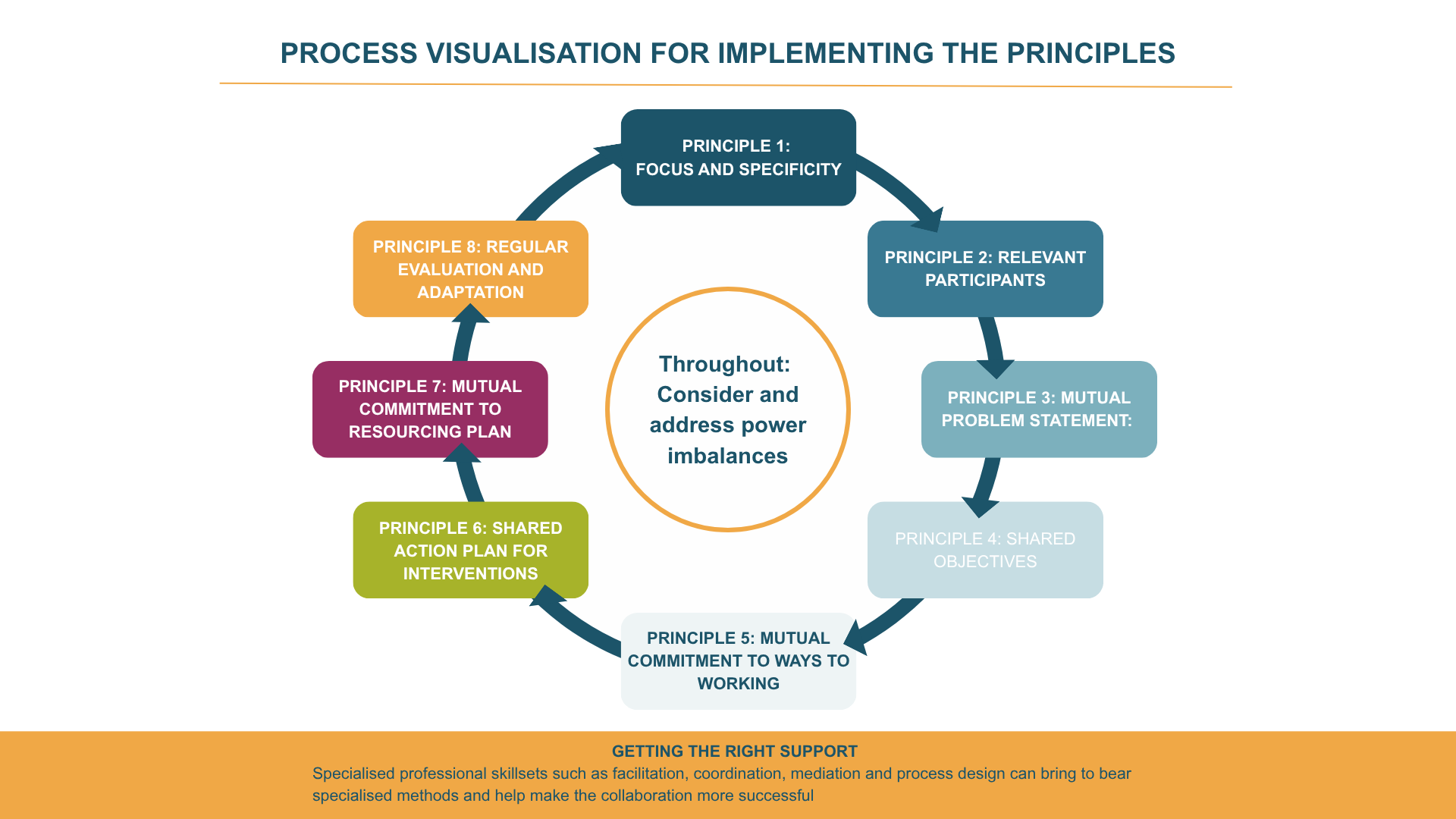
The table below provides a summary of the principles. The visualisation immediately following the table shows how the principles can be implemented as a process. The full document provides in-depth guidance points on each principle, lays a case for the value of local collaborations, and also provides practice tips for businesses that are getting ready to participate in collaborations and want to understand their role and how to get started.
- PRINCIPLE 1: FOCUS AND SPECIFICITY
-
To ensure that all participants and their stakeholders are clear about what salient issues are at hand and who is involved, the participants in the collaboration should be specific about and agree upon the focus geography, the specific salient issues they seek to address, and the way(s) that the business(es) are connected to the salient issues (causal, contributory, direct linkage)
Read the guidance points in the full publication
- PRINCIPLE 2: RELEVANT PARTICIPANTS
-
To ensure the planned interventions can be effective and reflect the fulfilment of responsibilities of those involved in the salient issues, the collaboration must include the right set of relevant participants. Mandatory participants include businesses -- particularly those causing the issues -- as well as representatives of rightsholders. Additional useful participants may include businesses that are directly linked to the salient issues and governmental representatives.
Read the guidance points in the full publication
- PRINCIPLE 3: MUTUAL PROBLEM STATEMENT
-
To ensure that all participants and their stakeholders are clear about the salient issues that the collaboration will seek to address, the participants in the collaboration should be specific about and establish consensus upon what and who is causing or contributing to the salient issues, as well as why.
Read the guidance points in the full publication
- PRINCIPLE 4: SHARED OBJECTIVES
-
Participants in the collaboration must identify and be explicit about their shared objectives for the collaboration. The objectives should focus on outcomes rather than outputs. It can be useful to be open about additional objectives held by individual participants.
Read the guidance points in the full publication
- PRINCIPLE 5: MUTUAL COMMITMENT TO WAYS OF WORKING
-
Participants in the collaboration should have clearly articulated ways of working that are agreed upon by all participants. This includes elements such as facilitation and mediation and assigning responsibilities for conceiving, delivering and evaluating interventions by the collaboration.
Read the guidance points in the full publication
- PRINCIPLE 6: SHARED ACTION PLAN FOR INTERVENTIONS
-
Participants in the collaboration should work together to develop the action plan for the interventions they plan to take to address the salient issues. This is the 'how' and 'what' of the collaboration. It should take a root causes approach and must be informed by appropriate expertise as well as the perspectives of rightsholders.
Read the guidance points in the full publication
- PRINCIPLE 7: MUTUAL COMMITMENT TO RESOURCING PLAN
-
Once the participants have devised their action plan, they need to agree on a resourcing plan to enable the plan to come to life. All participants must commit resources -- which does not necessarily have to mean money; it can also mean expertise or human resources. Where funding and/or appetite (buy-in) for the collaboration falls short of what would be needed to achieve the desired outcomes, the resourcing plan should address how to extend funding and appetite.
Read the guidance points in the full publication
- PRINCIPLE 8: REGULAR EVALUATION AND ADAPTATION
-
Participants need to develop and execute a plan to ensure that the entirety of the collaboration is subject to regular evaluation and adaptation, should the evaluation indicate that adaptation is necessary.
Read the guidance points in the full publication