

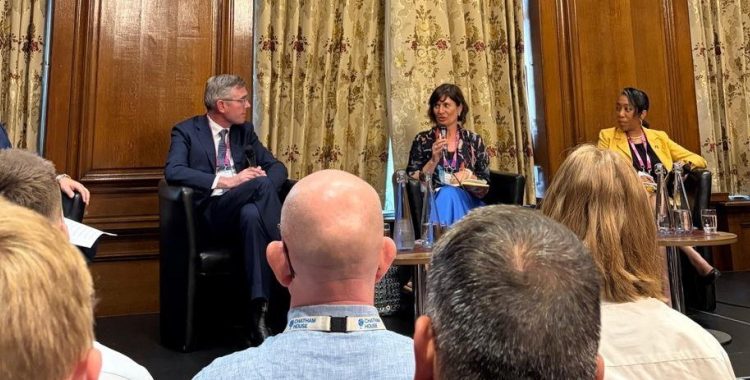
Our Founder and CEO, Estelle Levin-Nally, spoke at Chatham House's 2026 flagship London Conference in a spotlight session on "Critical minerals: building durable strategies for an era of competition." The Q&A below is drawn from her remarks on the day.
What needs to be in place for producing countries to get the most value from their minerals?
I first want to challenge the common conception that value addition primarily comes through beneficiation of the mineral. Beneficiation is of course a highly important part of retaining value within a country, and it is where a lot of development finance and private capital is going, because it fits with the minerals security agenda of G7 nations. What the UK, EU and US are trying to achieve is security of mineral supplies to support their industrial development and economies, so the obvious place to start is to prevent the shipment of ore and cathodes and instead ensure the shipment of wires or cabling, for example. That matters. But there are other aspects of the mineral economy where we can unlock additional value.
- One is simply maximising the resource. We may be seeking a particular mineral and hold the rights for that mineral, but in the tailings and the waste, or in metal that has been smelted but not yet fully refined, there are byproducts that also have value. Precious metal streamers already see this and act on it: they will finance the development of a copper mine in exchange for the offtake of its gold and precious metals, for example. So how do we take our tailings and reprocess them for minerals we may not originally have been looking for, but want now?
- Then there are backward linkages. We're currently helping an impact investor build a pipeline of investments across Africa, and to date we have found 135 opportunities. When we did a landscape analysis of where capital in the sector was flowing, we told them their capital is unique: it's patient, and it's looking to drive development, whereas much of the capital coming into our sector doesn't have those qualities. So where should it go? We concluded that backward linkages are a huge opportunity for value addition. Local content, supplier development, and financial services within mining communities unlock entrepreneurial possibility, and they drive industrial diversification at the mine site and at processing sites too.
- The third is human development. We unlock value when we develop people to become more competent and move into higher-capability roles. Mining companies and mineral sectors that focus on the development of people are adding value.
- And finally, wearing my gender hat as a proud member of the Women in Mining UK Policy and Research Committee and a former advisor to the G7 on gender equality, we unlock value by empowering women to participate fully in these sectors as entrepreneurs and business owners, and in the roles they hold within companies. We still have a long way to go. But the market leaders in women's economic empowerment have been able to prove that when women can participate fully and comfortably, and realise their potential, that unlocks economic value for them and their households, and for companies and nations too.
We've heard about the good approaches. How do we prevent the bad ones? What does responsible sourcing require?
We need humility. Mining is a tremendously complicated endeavour. We have to have the confidence to go in and break ground; we have to know so much and do so much; we're risk-takers with capital; and we work at the interstice between quite different cultures when an international operator arrives in a place where local communities will be affected. It's complicated.
We've worked with industrial miners all over Africa, across mineral categories including critical minerals, and in some of the most conflict-affected parts of the continent, among them northern Mozambique, the DRC and Burkina Faso, often helping industrial mining companies deal with artisanal and small-scale mining on their concessions. What we see is that things go wrong when companies aren't good at listening, and when they don't respect the perspectives of local people.
Companies insist on leading with compliance and property rights, rather than understanding that the rights regimes and customs of local communities may vest greater priority in their traditions than in what the state may say or do. There is often a high degree of disenfranchisement of local communities from the state, because they have been let down, or preyed upon. In some communities I've worked in there is not just antipathy but youth fury towards elites and elders. Power may not sit with traditional authorities; it may sit with migrant communities, as we have found in numerous jurisdictions. An insistence on engaging only those who are legal or formal, those vested with formal authority, leads to blind spots, greater fragility and destabilisation.
That's why I talk of humility. Of course we must protect the investment we've put in. We have to abide by the law, our corporate values, and our policies and procedures. But we come from quite different ways of seeing and knowing than many of the communities with whom we work, and there may be differences even between the elites in the capital city who lead in government or corporate headquarters and those on the ground.
So we need excellent social performance people, and we need them to be well resourced. We need boards that are willing to listen, and that understand soft skills are as important as the quantitative inputs we depend on for decision-making, whether financial or geological.
It's also about shared value. We're seeing some genuinely innovative approaches: mines that are Indigenous-owned but operated by a major, like Teck, or Golkor, a company in West Africa that gives 25% ownership to local communities in every project it enters, and makes it work. I was a commissioner on the Global Investor Commission on Mining 2030, and the Commission produced a paper looking at the different ways of driving shared value, equity and fairness, so that local communities have greater agency in making decisions and harnessing the benefits that come from mines.
Without that, we can't get the social licence to operate, and we can't deliver the positive impacts that the mineral endowment should be giving. Humility, listening and fairness is how we don't mess it up.
With so much money flowing into the sector, is there a risk that ESG requirements get watered down?
As a qualified and practising board director, I would say that no decent board is going to allow a mining company not to take its ESG risks seriously. When you don't take them seriously, you end up with conflict, higher local fragility, operational disruption, lawsuits, and reputational damage. The business case for strong ESG management extends beyond any requirements business partners might impose. It's something decent and compliant boards, within the context of their existing fiduciary duties, should just be doing as standard.
What about corruption?
I agree this is an ongoing challenge. It's also a sensitive subject. In some settings it can be seen as neo-colonial to talk about it or to take action on it. But there is progress. The risk is elevated, but the instruments available internationally for addressing it are growing. The EITI is continuously evolving its tools and standards. The digitisation of cadastres and of mineral value chain traceability supports anti-corruption efforts and is worth keeping a focus on.
What I haven't seen, and I'd love to know if this has changed, is a country commissioning a UNCAC sector assessment for its mining and minerals sector. The United Nations Convention Against Corruption has a methodology for examining the nature of corruption risks within a jurisdiction. When you unpack that and put a corruption action plan in place, you can build investor confidence and address the problem.
Can communities benefit this time, or will critical minerals repeat the displacement and land loss seen in the oil era?
I hate to say this, but I think it's inevitable that with growing demand for minerals there will continue to be displacement. What I would hope is that leading practice, in how you design the mine, in shared value, in proper participation and meaningful stakeholder engagement, can minimise the harms; can ensure displacement happens only where absolutely necessary; and, when it does happen, that it delivers for local people. I respect and understand that this is probably not the preferred answer from a local community's perspective. But it's the pragmatic answer, and the best I can offer.
